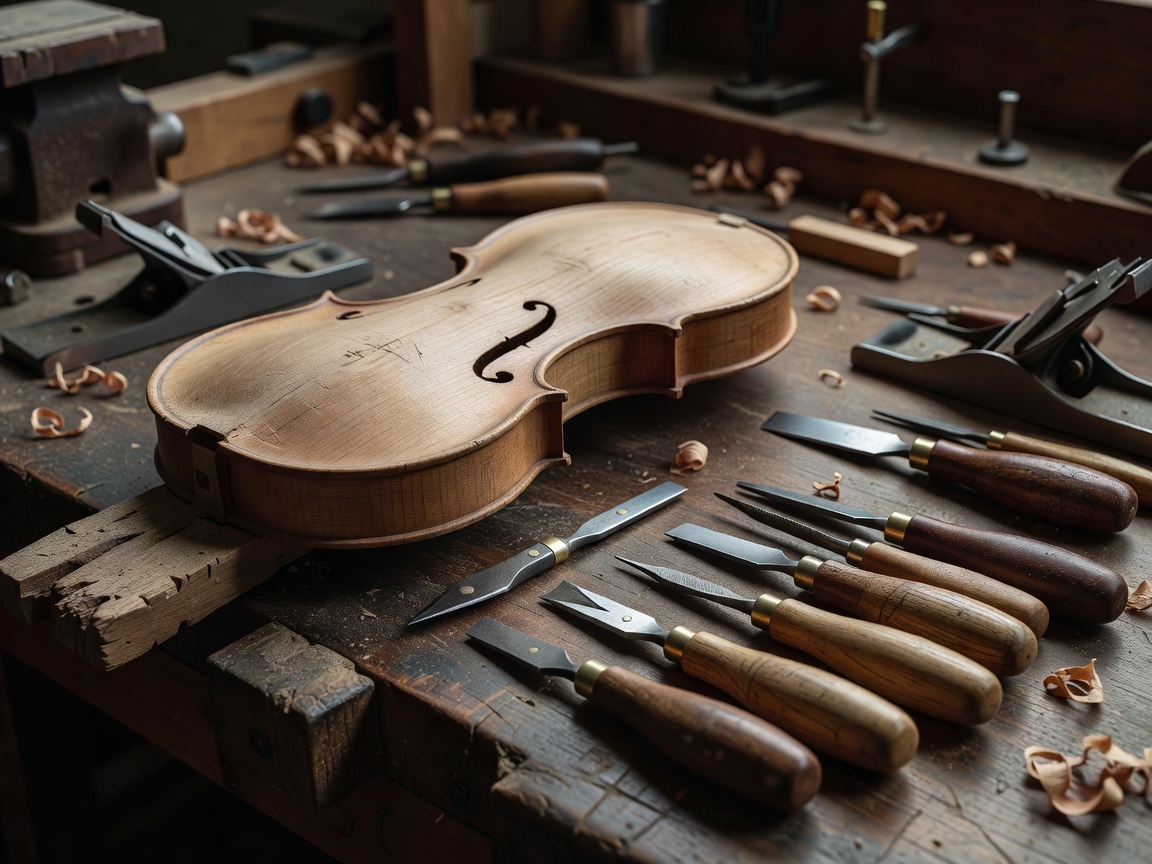
Three different kinds of participation
Workshop titles are not always consistent, so look past words such as “masterclass,” “taster” or “maker day.” Ask the organiser to describe the actual format. A demonstration is led by a maker and designed primarily for observation. Supervised practice gives participants a limited task with instruction and oversight. Specialist work may teach an advanced technique or focus on one instrument family and expect prior experience. These formats can all be valuable, but they offer different levels of access and responsibility.
- Demonstration: watch and question
Expect to follow a process, hear the maker’s reasoning and ask questions. Tool handling may be restricted. A realistic takeaway is better understanding, vocabulary and a set of next questions.
- Supervised practice: try a defined task
Expect a prepared exercise, clear boundaries and an instructor who checks your work. The outcome might be a sample piece or a first experience of marking, shaping or fitting—not a complete playable instrument.
- Specialist session: focus and prerequisites
Expect a specific craft area, tool set or instrument family. Ask what skill level is expected, what materials are supplied and whether the session includes individual feedback.
Match the workshop to your reason for going
If you are a musician who wants to understand how an instrument is built, a demonstration may be a strong first step. You can observe the order of work without the pressure of producing a result. If you want to experience a hand operation, look for supervised practice with an explicit beginner pathway and prepared material. If you already make or repair instruments, search for a specialist session that states its prerequisites and identifies the technique in detail. A course that is right for one learner may be frustrating or unsafe for another.
Think about your instrument family. A woodwind repair lesson may include keys, pads and sealing; a bowed-string session may discuss plates, bridges or setup; a guitar-making workshop may focus on body construction, neck geometry or finishing. A metalworking class for brass instruments has different equipment and safety needs again. A broad introduction can compare ideas across traditions, but it should not suggest that one practical technique transfers unchanged from one instrument to another.
Questions to ask before booking
- What will I observe or do? Request a plain-language outline of the practical task and the time spent watching, discussing and practising.
- What is the expected experience? Ask whether a complete beginner is welcome and what prior tool use, musical knowledge or instrument experience is assumed.
- What is provided? Clarify materials, tools, protective equipment, clothing guidance and whether you should bring an instrument.
- How is safety managed? Ask who supervises the group, how many learners attend and which operations are restricted to the instructor.
- What can I take away? Confirm whether you leave with notes, a practice sample, a completed object or only the learning experience.
- What is outside the session? Ask whether instrument repair, individual diagnosis, follow-up advice or a finished playable instrument is included.
Good organisers can explain limitations without diminishing the workshop. A clear statement that participants will watch a specialist operation is more useful than a vague promise of “hands-on mastery.” If the workshop uses valuable instruments or specialist tools, ask how the instructor decides what learners may handle.
Skill, supervision and safety
Skill develops through repeated practice, feedback and increasingly demanding tasks. A single session can open a door, but it cannot guarantee mastery of carving, fitting, voicing or repair. The instructor should distinguish observation from practice and supervised practice from independent work. They should also make clear that the right precautions depend on the operation. Sharp cutting tools, dust, finishes, powered equipment, springs and tensioned parts require different controls.
Participants should follow the instructor’s directions, use protective equipment as required and stop if they are unsure. Tell the organiser about relevant access needs, allergies or limitations before the session so they can explain whether an activity can be adapted. Do not bring a valuable instrument for an unplanned repair. Ask first whether the class is equipped to handle it and whether the instructor offers individual assessment.
Reading the experience, not the promise
Useful signs include a named instructor with relevant experience, a clear schedule, a stated group size, transparent costs and a description of the tools and materials. A workshop may have a particular traditional lineage, a contemporary method or a mix; it is reasonable to ask which. If the organiser describes a technique as historical, ask what source or tradition they are referring to. If they show a close-up photograph, do not assume it depicts the instructor’s own bench unless that is stated clearly.
Consider how you learn best. Some visitors prefer to watch a slow demonstration and ask questions. Others benefit from trying one small task with the instructor nearby. A musician may want to understand how a repair affects playability, while a curious beginner may want to see how raw material becomes a component. There is no need to choose the most advanced option to have a worthwhile experience. Choose the session whose stated outcomes match your purpose.
Prepare a useful enquiry
Briefly introduce yourself, mention your experience, name the instrument family that interests you and ask what the session includes. Explain whether you hope to observe, practise or develop an existing skill. Ask about accessibility and safety directly. You can use the site’s message preparation tool to write a plain-text enquiry, review it, then copy or download it; the tool does not transmit messages. Before you send anything from your own email account, confirm the workshop’s contact details independently.
For foundational reading, see material selection, construction and setup. The right workshop should leave you with a clearer picture of the work, its boundaries and the next question you want to ask.